Your CGPA (Cumulative Grade Point Average) decides your class of degree, whether you can move to the next level, and often whether you qualify for a scholarship, NYSC placement or a postgraduate programme. Yet many students only find out how it is calculated when a result surprises them.
This guide explains the grading scale most Nigerian universities use, then walks through a complete example: turning scores into grade points, working out a semester GPA, and combining semesters into a CGPA.
The 5-point grading scale
Nigerian universities grade each course on a 5-point scale guided by the National Universities Commission (NUC). Your score in a course becomes a letter grade, and each letter grade carries a number of grade points:
Score | Grade | Grade points |
|---|---|---|
70 – 100 | A | 5 |
60 – 69 | B | 4 |
50 – 59 | C | 3 |
45 – 49 | D | 2 |
40 – 44 | E | 1 |
0 – 39 | F | 0 |
Check your handbook. Many universities have dropped the E grade, so the pass mark is 45 and anything below it is an F. Your student handbook says which version your university uses.
Units and quality points
Every course has a number of credit units (often 1 to 4). A 3-unit course counts three times as much as a 1-unit practical. To weigh each course properly, multiply its grade points by its units. The result is called the course's quality points (some departments say weighted grade points).
For example, an A (5 points) in a 3-unit course gives 5 × 3 = 15 quality points. A C (3 points) in a 2-unit course gives 3 × 2 = 6.
How to calculate your semester GPA
Your GPA for one semester is the total quality points divided by the total units you registered for:
GPA = total quality points ÷ total units
Here is a 100 Level first semester:
Course | Units | Score | Grade | Points | Quality points |
|---|---|---|---|---|---|
GST 111 | 2 | 68 | B | 4 | 8 |
MTH 101 | 3 | 74 | A | 5 | 15 |
PHY 101 | 3 | 55 | C | 3 | 9 |
CHM 101 | 3 | 47 | D | 2 | 6 |
COS 101 | 3 | 62 | B | 4 | 12 |
PHY 107 | 1 | 81 | A | 5 | 5 |
Total | 15 | 55 |
GPA = 55 ÷ 15 = 3.67.
How to calculate your CGPA
Your CGPA combines every semester so far. The key rule: add up all the quality points and all the units, then divide once. Don't average the GPAs.
Suppose the second semester went like this:
Course | Units | Score | Grade | Points | Quality points |
|---|---|---|---|---|---|
GST 112 | 2 | 72 | A | 5 | 10 |
MTH 102 | 3 | 66 | B | 4 | 12 |
PHY 102 | 3 | 58 | C | 3 | 9 |
CHM 102 | 3 | 71 | A | 5 | 15 |
COS 102 | 3 | 64 | B | 4 | 12 |
STA 112 | 2 | 52 | C | 3 | 6 |
Total | 16 | 64 |
Second semester GPA = 64 ÷ 16 = 4.00.
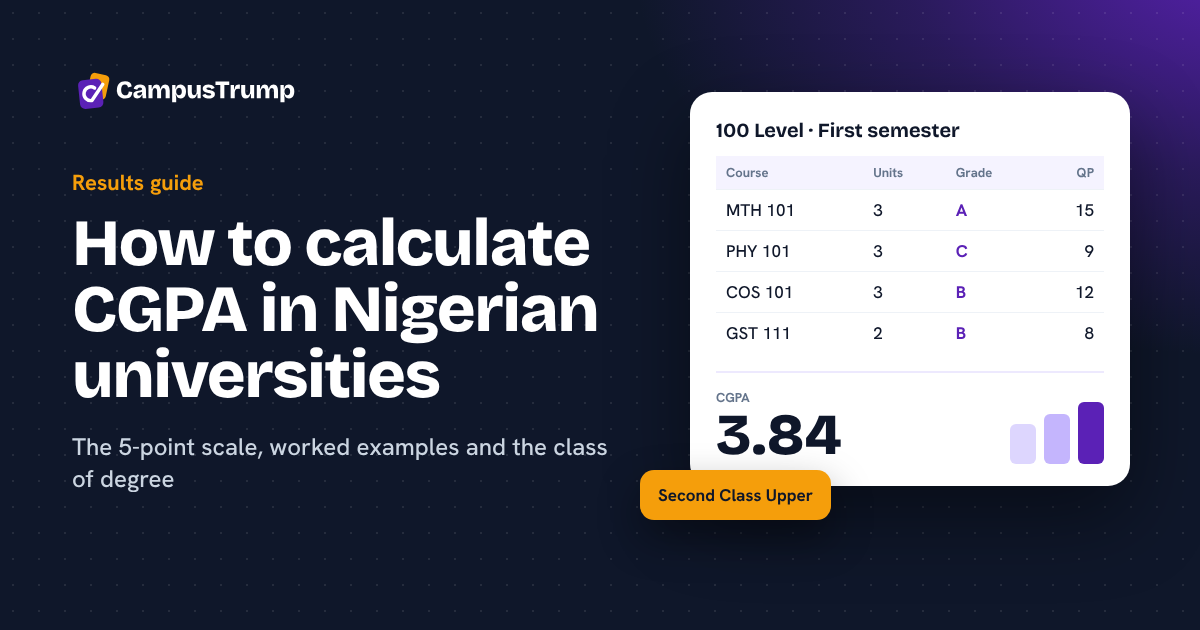
CGPA after 100 Level = (55 + 64) ÷ (15 + 16) = 119 ÷ 31 = 3.84.
Notice that the second semester had more units, so it pulls the CGPA a little further. That is exactly why averaging the two GPAs gives the wrong answer as soon as semesters have different unit loads.
Class of degree
At graduation, your final CGPA places you in a class of degree. The usual bands are:
CGPA | Class of degree |
|---|---|
4.50 – 5.00 | First Class |
3.50 – 4.49 | Second Class Upper (2:1) |
2.40 – 3.49 | Second Class Lower (2:2) |
1.50 – 2.39 | Third Class |
Universities that still use the E grade may also award a Pass degree for a CGPA between 1.00 and 1.49. The student in our example, on 3.84, is on course for a Second Class Upper.
Common mistakes that throw your CGPA off
Averaging GPAs. Always divide total quality points by total units, as above.
Forgetting failed courses. An F still counts: its units stay in the total with 0 points, until your university's carry-over rules say otherwise. How a passed resit replaces or sits beside the F differs between universities.
Using the wrong units. Take units from your course registration form, not from memory.
Rounding too early. Keep full numbers until the end, then round to two decimal places. Some universities cut off (truncate) instead of rounding, which matters right at a boundary like 4.495.
What CGPA do you need next semester?
To aim for a target, work backwards. Say you have 119 quality points from 31 units and next semester you'll take 17 units. To reach a CGPA of 4.00 you need 4.00 × (31 + 17) = 192 quality points in total, so 192 − 119 = 73 from the new semester. That is a semester GPA of 73 ÷ 17 = 4.29.
How universities can stop calculating CGPA by hand
For students the arithmetic is simple; for a results office handling thousands of students and hundreds of courses, it's where mistakes creep in. A university results system should take each lecturer's scores, apply your grading scale and units, and produce semester GPA, CGPA and class of degree with no spreadsheet copying.
That's what CampusTrump's university portal does: lecturers enter scores per course, the system works out GPA and CGPA on the 5-point or 4-point scale, and students see their results and CGPA trend in their own app. Results come out as PDFs with a QR code, so anyone can check a result is genuine.